What sets PapaiArt Animation Studio apart
Digital art and animation have long been split between large, all-purpose industry standards. For 3D modeling creators turn to the big packages, and for 2D animation they end up using a completely separate ecosystem. PapaiArt Animation Studio tries to bridge that gap with a single hybrid animation software aimed at creators who work in both.
2D and 3D in one workspace
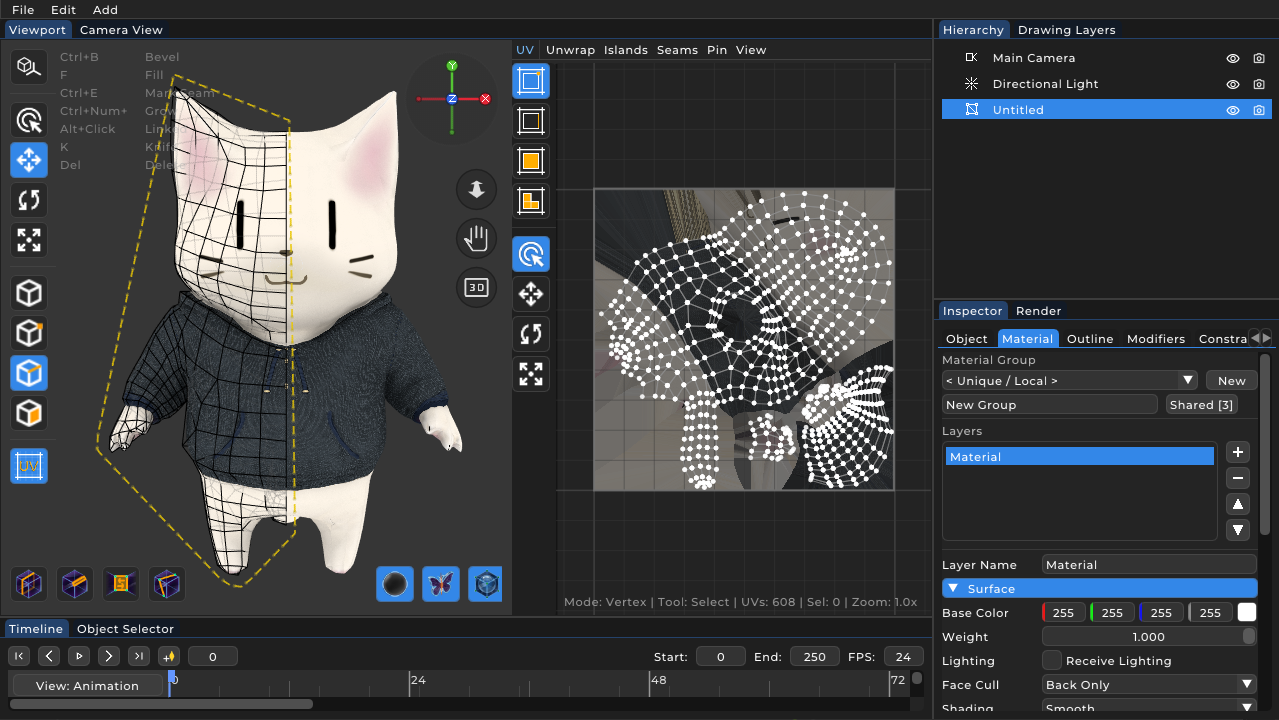
The defining feature of PapaiArt Animation Studio is spatial drawing. Most other tools are built on either a 3D or a 2D engine. This software puts a 2D drawing engine directly into the 3D workspace. You can make frame-by-frame 2D animations on drawing layers while using 3D cameras, lighting and depth at the same time. The result is a workflow that opens up "2.5D" visual styles which are awkward to produce in either type of tool alone.
Lightweight and focused
Large industry packages are easy to bog down with features, and they often demand high-end hardware for fairly simple tasks. PapaiArt Animation Studio runs on a custom engine written for real-time use, so it starts quickly, stays responsive and keeps memory use low. The interface is built from a small set of dockable panels, so you only see the tools you actually need for the current task.
Rigging and modeling without compromise
Being lightweight does not mean cutting features. A clean hierarchy panel and a modifier system (including Mirror and Subdivision Surface) cover non-destructive 3D modeling. Character rigging is handled by built-in constraints: Inverse Kinematics (IK), TrackTo, ChildOf, Copy and Limit. This is a level of rigging that is unusual to see in a package this small.
Built-in video export
One of the friction points in many animation workflows is having to round-trip image sequences through a separate video editor. PapaiArt Animation Studio includes a built-in MP4 (H.264) video encoder. The contents of the timeline can be exported directly as a shareable video file in one step.
In short: PapaiArt Animation Studio doesn't try to be a tool for everyone. It is a focused animation tool that brings together 2D drawing, 3D space, rigging constraints and direct video export in a single package.